“In our classes, we would have conversations about racism and sexism. How it begins with having a prejudice, and then prejudice turns into discrimination, and then discrimination turns into oppression,” Ferraro said. “That is very deeply tied to ‘Dead Man Walking’ and a lot of Sister Helen’s work.”
“Dead Man Walking” follows Prejean’s experiences as a spiritual advisor to two men convicted of murder on death row, exploring themes of mercy and the human dignity of both victims and those convicted of crimes. Maria Milliman ’27, a business management major, approached the book from a literary perspective in her world literature course.
“We were working in class on structures of conflict in literature,” Milliman said. “We had a lot of good discussions about what Sister Helen went through.”
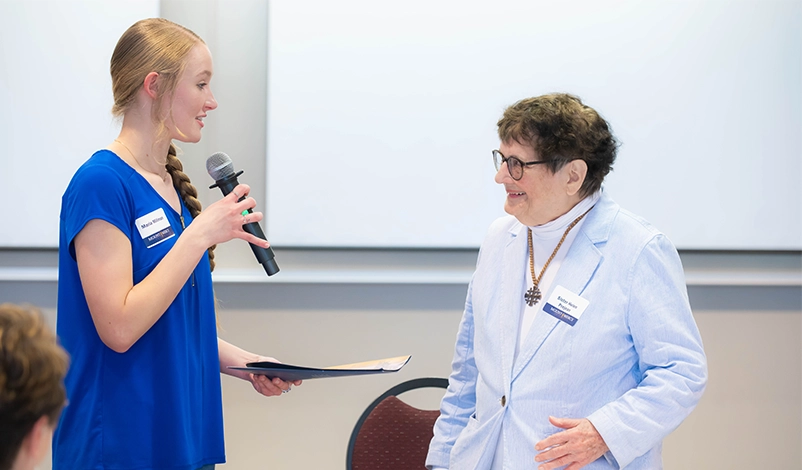
At the end of the unit, students were asked to write letters directly to Prejean as a way to reflect on the book and explore how they personally connected with its themes. Milliman had the opportunity to offer the letters directly to Prejean during the luncheon.
“We wrote letters to Sister Helen, just thanking her and sharing our thoughts,” Milliman said, describing the assignment as a way to respond personally to the story beyond class discussion.
Making the story real
While classroom discussions introduced students to the book’s themes, Prejean’s campus visit on April 13 made those ideas tangible. What had once been a story on the page became grounded in real people, real relationships, and lived experiences.
“It’s really cool,” Ferraro said. “When you read the book, you know it’s a real story, but it still sometimes feels like characters. Then hearing her talk about the characters as people she actually knew, it just makes it even more real.”
Milliman said the in-person experience deepened her understanding of the story.
“Having the graphic novel helped me actually see it all and walk through the story,” she said. “And now getting to hear her talk about it, I’m excited to hear more about her perspective.”
Learning through encounter
That accessibility of the text in class, paired with the chance to engage directly with the author, allowed students to move beyond passive reading into active dialogue.
During the open forum, student Matthew Schaul ’29 connected his question directly to his experience reading the book in class.
“I am a Catholic myself, and sometimes I find it hard to see the good in others,” Shaul said to Sister Helen. “But in your instances, you’re able to see the good in people regardless of their past. It’s helped me think more ethically about my everyday life.”
He then asked how others can learn to recognize that same dignity – a question shaped by both classroom discussion and personal reflection. In response, Prejean emphasized that education is not just about absorbing information, but about transformation through encounter.
“You have to be brought into the experience,” she said, explaining that real learning happens when people move beyond ideas and come into contact with real human stories.
She challenged students to let what they learn shape how they see others.
“Who’s been able to see the good in you?” she asked Shaul.
A call beyond the classroom
Prejean encouraged students to carry their education beyond the classroom and into their everyday lives.
“Push yourself to get out of the comfortable circles that you always move in,” she said. “Get to the margins, get to people not like you.”
She framed education as something that should lead to action and deeper awareness.
“When you learn, it’s not just for you,” she said. “It’s meant to open your eyes and change how you live.”
She also emphasized the connection between faith and justice.
“The connection between your Catholic faith, the gospel of Jesus, and justice, is what I want everyone to take from this” she said.
Faculty noted the visit reflected Mount Mercy’s mission and created space for students to live out those values in a tangible way.
“Sister Helen’s work is so well aligned with our critical concerns, particularly to nonviolence, human dignity, and care for those who are marginalized,” said Lacey Ritter, PhD, assistant professor of sociology.
A defining moment in learning
For students, the experience ultimately demonstrated the power of education that extends beyond the classroom, one that challenges assumptions and connects learning to real-world issues.
“It’s bigger than me,” Prejean said. “The story’s getting out there. People are reading the book, and here we all are.”
By the end of the day, what began as a required reading assignment had become something far more personal. Students were no longer just analyzing a text. They were questioning it, responding to it, and engaging directly with the person behind it.
In doing so, they experienced what many described as a defining moment of their education: not just learning about justice, mercy, and human dignity, but being invited to live those values in real time.
Sister Helen Prejean Peace & Justice Scholarship
Prejean’s life and work will continue to impact students at Mount Mercy for years to come. During the April 13 event, President Todd Olson, PhD, announced a new student scholarship in honor of Prejean. The Sister Helen Prejean Peace & Justice Scholarship will be an annual, donor funded scholarship in honor of her life's work.